
RDM Weekly - Issue 001
A weekly roundup of Research Data Management resources.


Welcome to the inaugural RDM Weekly Newsletter!
I am so excited you are here and I look forward to sharing research data management resources with you every Tuesday! It was very tough choosing which resources to include in this inaugural newsletter. If anything though, this hopefully should indicate to you that there are MANY more great resources to come in future newsletters so definitely consider subscribing so you don’t miss out!
Each week the content will be divided into 3 categories:
☑️ What’s New in RDM?
These are resources that have come out within the last year or so
☑️ Oldies but Goodies
These are resources that came out over a year ago but continue to be excellent ones to refer to as needed
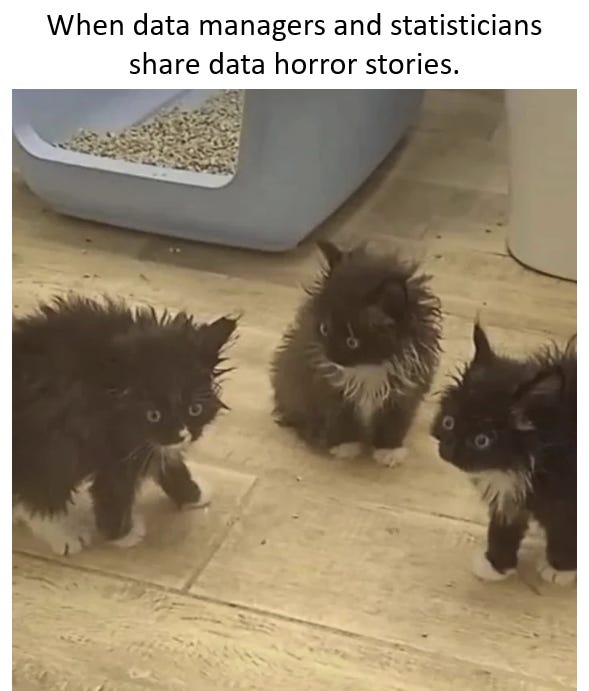
☑️ Just for Fun
A data management meme or other funny data management content
What’s New in RDM?
Resources from the past year
1. Supporting Scientific Data
An in-process open access guide consisting of a growing list of chapters, each covering a major topic in data management. The chapters are complemented by a variety of explainers, checklists, and templates.
2. Psych-DS Community Data Standard and Technical Specification
Although the Psych-DS data standard and technical specification has been around for years, most recently, the team has formalized documentation and created a validator tool to test if a dataset meets the Psych-DS specifications.
3. Data Deidentification for Data Sharing in Educational and Psychological Research: Importance, Barriers, and Techniques
This preprint presents techniques for data deidentification and makes recommendations for which techniques are relevant for specific types of variables. An interactive tutorial is also included to assist readers in trying out different deidentification techniques.
4. What Makes a Good Variable Naming Convention?
There has been a lot written about variable naming conventions over the years but I appreciate this fresh look at naming variables, with a particular focus on ways naming conventions can make working with longitudinal, or panel data, more efficient.
5. From Overwhelm to Organization: Optimizing Data Workflows in R
In this blog post and video, David Keyes shows us how to organize an R project for easier maintenance and reuse. He demonstrates how to move from a sprawling script that handles everything—data loading, cleaning, analysis, and visualization—to a cleaner workflow that
Separates data cleaning and analysis into distinct scripts
Saves cleaned data as RDS files for efficiency
Structures the project with folders for raw and processed data
Uses source() to streamline workflows
6. Open Science in the Developing World: A Collection of Practical Guides
This project brings together 45 contributors from 20 countries to address a critical question: How can Open Science be made truly accessible, inclusive, and practical for researchers in low-resource and non-Western settings? The authors created a series of actionable, contextualized guides, covering challenges like language barriers, infrastructure gaps, and local norms, to support researchers in adopting transparent and reproducible practices on their own terms.
Oldies but Goodies
Older resources that are still helpful
1. Three Reasons Education And Social Scientists Prefer Proprietary Software And Data Formats
This blog post reviews some of the reasons that social scientists tend to gravitate towards proprietary software such as SPSS or Stata, and in particular highlights some of the benefits of these tools, such as their standard metadata features. The author then suggests that if we want data managers to use “open software and data formats, we need to provide them with an ecosystem that makes their jobs easier”, and discusses potential solutions for moving researchers towards using non-propietary software in the future.
2. Dryad’s Quickstart Guide to Data Sharing
There have been a lot of diagrams and flow charts developed to assist researchers with the decision making process associated with data sharing, but I really appreciate the simple, easy to follow format of this infographic from Dryad.
3. Introducing the Data Cleaning Day
An excellent reminder to set aside time to get your data, files, and processes in order, no matter the size of your organization. Data Orchard shares insight into the impact a data cleaning day had on their organization, stating that it provided “an opportunity to collectively agree how to approach things and make judgement calls on how to make improvements so it works for everyone”.
4. Making Research Data Publicly Accessible: Estimates of Institutional & Researcher Expenses
This mixed-methods study collected data from 6 academic institutions that offer DMS services, as well as funded researchers at those institutions who completed a Department of Energy (DOE), National Institutes of Health (NIH), or National Science Foundation (NSF) grant between 2013 and 2022 in one of the following disciplines: biomedical sciences, environmental science, materials science, physics, or psychology. The report provides findings regarding institution and researcher DMS expenses as well as recommendations moving forward.
Just for Fun
Thank you for checking out the RDM Weekly Newsletter! If you enjoy this content, consider supporting this work through Buy Me A Coffee.