


Welcome to Issue 2 of the RDM Weekly Newsletter!
The content of this newsletter is divided into 3 categories:
☑️ What’s New in RDM?
These are resources that have come out within the last year or so
☑️ Oldies but Goodies
These are resources that came out over a year ago but continue to be excellent ones to refer to as needed
☑️ Just for Fun
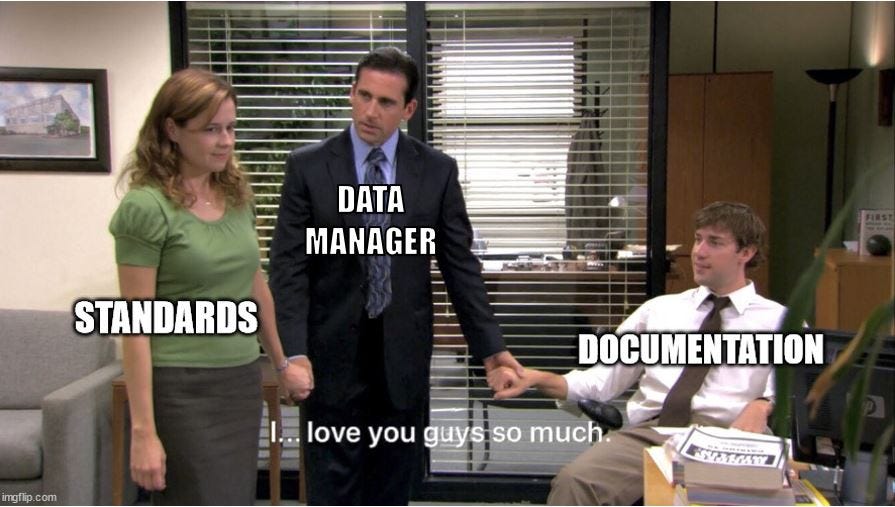
A data management meme or other funny data management content
What’s New in RDM?
Resources from the past year
1. Michigan ADRC Data Sharing Hub Resource Library
Curated by the Michigan Alzheimer’s Disease Center’s (MADC) Data Core, this resource library offers a growing collection of tools, tutorials, and references designed to support both new and current staff in building technical skills that enhance the Center’s daily operations. Built as an open access site, external users can also benefit from the resource library as well.
2. Eleven Quick Tips for Properly Handling Tabular Data
This paper offers a fresh look at best practices for organizing tabular data, with a focus on ensuring that the data meets the FAIR principles—findable, accessible, interoperable, and reusable. While all of the tips are helpful, I especially appreciate Figure 1 which provides all 11 tips in one concise, easy to refer to, visual.
3. Most People Have No Idea Their Surveys Are Bad
In this blog post, Kirsten Lee Hill discusses four common pitfalls when designing surveys and then reviews what these mistakes look like in practice. She then goes on to let the reader know why survey design mistakes are so problematic and provides some solutions for collecting better data.
4. CESSDA Data Citation Guide
This Data Citation Guide begins by explaining why data citation matters and what a data citation should include. It then offers targeted and practical recommendations for different stakeholder groups.
5. Intro to Git & GitHub (Speedrun Edition)
This lesson combines and modifies content from the Software Carpentry Version Control with Git lesson, the Carpentries Incubator Version Control with Git lesson that incorporates branches and PRs, and the Library Carpentry Introduction to Git lesson. This remixed workshop prioritizes speed and can be taught in 90 minutes, rather than 4 hours. Another big change is that the storyline for this workshop is fully themed for Loki as the God of Stories in the multiverse.
6. Exploratory Data Analysis in Python
Exploratory Data Analysis, or EDA for short, is one of the most important parts of any data science workflow. Understanding your data and identifying potential biases is extremely important for all subsequent steps. This blog post reviews a few libraries in Python that can help simplify some steps in the workflow. Are you an R user? There is also a complementary blog post for R!
Oldies but Goodies
Older resources that are still helpful
1. Systematic Data Validation
This slide deck provides an overview of what data validation is and why it’s important, and also presents criteria for assessing a high quality dataset. Last, the presentation reviews a series of checks to include in a data validation process.
2. Data Curation Primers
Data curation primers are peer-reviewed, living documents that detail a specific subject, disciplinary area or curation task and that can be used as a reference to curate research data. Authors of primers include archivists and data librarians who attended the 2018-2020 Specialized Data Curation Workshops presented by the Data Curation Network.
3. Research Data Documentation Methods
This handout summarizes a range of documentation methods for research data, including: laboratory notebook, e-lab notebook, README.txt, template, data dictionary, codebook, metadata schema, standard, and taxonomy. The handout describes when to apply each documentation type and what information the method covers.
4. Eight Principles of Good Data Management
This blog post is the second in a series of posts about data management practices from Teague Henry. In this post, Teague walks us through 8 principles of good data management, informed by his own experiences with data management and analysis. The principles covered are ones that he personally tries to follow to protect his own work against mistakes, to save time, and to make it easier to collaborate with others.
Just for Fun
Thank you for checking out the RDM Weekly Newsletter! If you enjoy this content, please like, comment, or share this post! You can also support this work through Buy Me A Coffee.