
RDM Weekly - Issue 026
A weekly roundup of Research Data Management resources.


Welcome to Issue 26 of the RDM Weekly Newsletter!
The content of this newsletter is divided into 3 categories:
✅ What’s New in RDM?
These are resources that have come out within the last year or so
✅ Oldies but Goodies
These are resources that came out over a year ago but continue to be excellent ones to refer to as needed
✅ Just for Fun
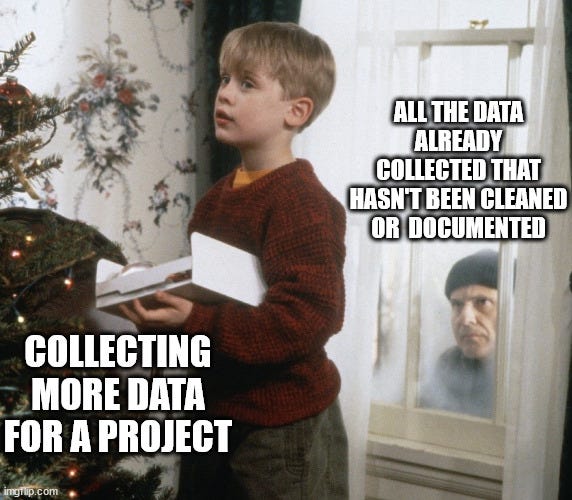
A data management meme or other funny data management content
What’s New in RDM?
Resources from the past year
1. Research Culture Uncovered Podcast
Across the globe, the urgent need for a better Research Culture in Higher Education is widely accepted – but how do you make it happen? This weekly podcast, from the University of Leeds, focuses on their ideas, approaches and learning as they contribute to the University’s attempt to create a Research Culture in which everyone can thrive. Whether you undertake, lead, fund or benefit from research - these are the conversations to listen to if you want to explore what a positive Research Culture is and why it matters.
2. Getting Creeped Out? Open Science, Qualitative Methods, and the Dangers of Positivism Creep
‘Open science’ initiatives such as study pre-registration (i.e., specifying research aims and analytical plan ahead of data access), open data sharing, open-access publication, and open materials sharing are becoming increasingly mainstream across many fields within social research and the natural sciences. While there has been much criticism of these interventions, largely from the qualitative research community, the authors want to draw attention to a troubling trend in the promotion of open science: the leaking of standards relevant only to quantitative research to all paradigms. Or, as others refer to it, “positivism creep”. The authors argue that the primary framing of open science as the pursuit of reproducibility and objectivity risks promoting positivism creep in the social sciences and humanities. In particular, they suggest that overly strict open research requirements placed by funders may reduce the range and variety of epistemological positions that can be taken by researchers, with particularly deleterious effects for qualitative researchers.
3. AI for Digital Repositories : FIDELIS Workshop - Webinar
Recent advances in Artificial Intelligence (AI), and Large Language Models (LLMs) in particular, are transforming the way we access and work with information. Well-annotated, structured data in digital repositories serve as valuable resources for building AI models and enable more interconnected, widespread access to knowledge. During the FIDELIS AI for Digital Repositories Workshop, presenters tackled practical use cases demonstrating how AI technologies can enhance the value of repository data, key concepts behind LLMs, and the ways in which the EOSC Data Commons project facilitates AI-driven data discovery. Slides from the webinar can be found here.
4. Program Evaluation Methods: 8 Steps to Clean and Prepare Your Data for Reliable Insights
Every evaluator and nonprofit program manager knows the feeling: a spreadsheet full of confusing columns, missing entries, and numbers that don’t quite add up. Whether you’re analyzing participation data or hundreds of post-event surveys, your findings can only be as strong as the data behind them. For nonprofit program evaluation, data cleaning isn’t an optional task—it’s a core step in ensuring your results are valid, credible, and ready for reporting. This blog post provides eight data cleaning steps that are designed for medium- to large-sized nonprofits conducting program evaluation or using survey data to assess program effectiveness.
5. Virtual Workshop - Creating an NIH Data Management and Sharing Plan with ICPSR - Recording
Are you preparing a renewal, resubmission, or upcoming NIH grant application? This interactive session will guide you through the essential components of creating an effective NIH Data Management and Sharing (DMS) Plan and highlight the value of transparent data sharing. You’ll gain insights into the NIH’s data sharing policies, learn how to de-identify and prepare both restricted- and public-use datafiles, and discover ICPSR’s many resources to support your research, whether you work with qualitative or quantitative data. The objectives of this workshop were to: 1) Understand NIH data sharing policies and the benefits of making data available, 2) Learn what information must be included in each of the NIH DMS Plan elements, 3) Explore best practices for de-identifying data and preparing datasets for sharing, and 4) Learn how ICPSR can help you meet NIH data sharing requirements. Slides from the workshop can be found here.
6. Don’t Panic: A Researcher’s Guide to Replication Packages
In this blog post from the Institute for Replication (I4R), the author reviews the importance of a README file in acclimating a user to a data package. The blog then reviews 5 steps to consider when developing a good README.
7. SORTEE Open Science Bingo
The SORTEE Open Science Bingo is a community-driven initiative designed to encourage, track, and celebrate the adoption of high-impact practices in transparent and reproducible research, particularly within the fields of Ecology, Evolution, and related disciplines. From Cecilia Baldoni, “Instead of leaving reproducibility goals to New Year’s resolutions, let’s celebrate the open science practices you’ve already achieved, and set fun targets for the new year!”. Have other ideas of open science practices to add? You can submit them as an issue directly to the repository.
Oldies but Goodies
Older resources that are still helpful
1. Things That Shouldn’t Be in File Names for $1,000 Alex
This short, fun blog post from 2007 is still very relevant today. The author runs through 10 things to avoid including in your file names, and provides solid reasons for avoiding them.
2. DMP Tool
The DMP Tool is a free, open-source, application that helps researchers create data management plans (DMPs), often required by funding agencies as part of the grant proposal submission process. The DMP Tool provides a click-through wizard for creating a DMP that complies with funder requirements (templates for many different funders are included). It also has direct links to funder websites, help text for answering questions, and data management best practices resources.
3. The TRUST Code: A Global Code of Conduct for Equitable Research Partnerships
Research partnerships between high-income and lower-income settings can be highly advantageous for both parties. Or they can lead to ethics dumping, the practice of exporting unethical research practices to lower-income settings. This Global Code of Conduct for Equitable Research Partnerships counters ethics dumping by providing guidance using a framework based on the values fairness, respect, care and honesty. More information can be found in this open access book as well. Thank you to Aleksandra Lazić for recently sharing this.
4. Introducing Reproducible Research Standards at the World Bank
In 2023, the World Bank launched a new initiative for reproducible research, which builds on the existing commitments to open data and open knowledge. The initiative aims to increase transparency of World Bank analytical products, through the publication of reproducibility packages that document the process of obtaining analytical results from the original data sets. Public reproducibility packages enable consumers of World Bank research to understand how World Bank staff derived their findings. This article describes the World Bank’s reproducible research initiative and their work developing reproducibility packages which accommodate a wide array of software and programming packages. To support development of these packages, the team is offering training and also building tools to make it easier to adopt reproducible practices, such as the repkit package, a Stata module providing a utility toolkit for making reproducibility best-practices more accessible to a wider Stata community.
Just for Fun
Thank you for reading! I plan to take a two week break from the newsletter for the holidays. Issue 27 will be out the first Tuesday in January! Happy New Year to you all!
As always, if you enjoy RDM Weekly, please like, comment, or share this post! You can also support this work through Buy Me A Coffee.