
RDM Weekly - Issue 031
A weekly roundup of Research Data Management resources.


Welcome to Issue 31 of the RDM Weekly Newsletter!
If you are new to RDM Weekly, the content of this newsletter is divided into 4 categories:
✅ What’s New in RDM?
These are resources that have come out within the last year or so
✅ Oldies but Goodies
These are resources that came out over a year ago but continue to be excellent ones to refer to as needed
✅ Research Data Management Job Opportunities
Research data management related job opportunities that I have come across in the past week. I have no affiliation with these jobs.
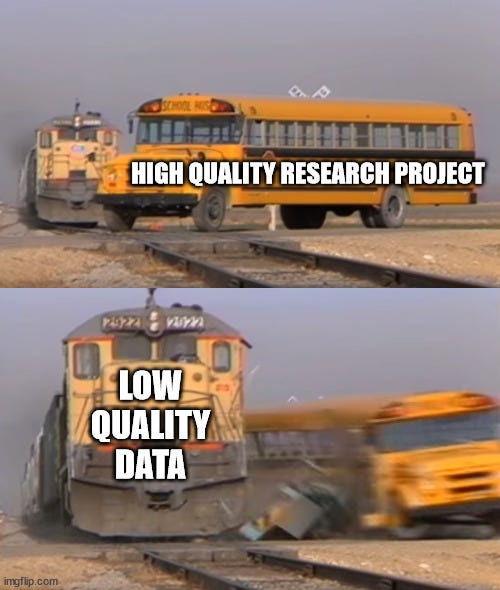
✅ Just for Fun
A data management meme or other funny data management content
What’s New in RDM?
Resources from the past year
1. ‘Don’t Hate the Players, Hate the Game’: Qualitative Insights from Education Researchers on Questionable and Open Research Practices
Both questionable (e.g. p-hacking) and open (e.g. pre-registration) research practices are prevalent in education research. Authors sought to understand the explanations given by educational researchers for why either should or should not be used. Two teams of researchers independently analysed open-ended survey responses from 1488 education researchers on their feelings about questionable and open research practices. Despite using different analytic approaches, all of the major categorizations of participant responses were similar or related across teams. Our findings suggest that although respondents believe that questionable research practices should not be used, they conceded there are systemic reasons some use them. Similarly, although respondents generally support open practices, they noted situations in which they were not appropriate or necessary for education research. These findings can serve as a catalyst for training and policy initiatives.
2. Integrating Accessibility into Institutional Repositories - Webinar
This panel, sponsored by ACRL STS Scholarly Communications committee, explores how various American universities are considering the accessibility of institutional and data repositories, in anticipation of the ADA Title II ruling coming into effect. The discussion will cover different strategies for ensuring content included in the repository meets compliance guidelines, as well as how repositories can make discovering items a more accessible experience. Panelists give a short presentation on the work they have undertaken to increase digital accessibility in repositories.
3. The Modern Guide to Research Participant Recruitment
Research recruitment fundamentals haven't changed. You still need good screeners, clear communication, fair incentives, and quality verification to source qualified (and quality) participants. What has changed is the context: AI has entered the fray, fraud has become industrial, and trust in participant quality is at a premium. This guide from User Interviews focuses on what it will take to move forward. They break down the participant recruitment landscape today vs yesterday, the new challenges and realities researchers face, and how to get on the path to modernize your participant recruitment efforts. Note: This guide is produced as part of company marketing, but still provides good information whether or not you use their product.
4. RDA 25th Plenary Meeting Programme
Slides and recordings from the Research Data Alliance 25th Plenary Meeting are available. There are tons of great talks worth checking out. There is a broad range of topics ranging from the evolution of RDM training, to managing drone data, to documenting LLM interactions, to assessing the value of research data. Research Data Alliance also recently announced the launch of the RDA-US 2026 Cohort, an exciting opportunity for U.S.-based participants interested in engaging more deeply with the Research Data Alliance (RDA) and leveraging it to advance their work, projects, and international collaborations. This cohort is designed for people who want to move beyond observing RDA and into active participation, contributing to Working Groups (WGs) and Interest Groups (IGs), building relationships across the global research infrastructure community, and strengthening U.S. engagement within RDA. Applications due by February 15, 2026.
5. Quick Improvements to Data Privacy: An Introduction for Leaders of Small Nonprofits and Agencies
The Massive Data Institute (MDI) at Georgetown University has released a brief on quick-to-implement privacy safeguards to protect sensitive data in resource-constrained community based organizations (CBOs) and government agencies. This brief describes simple strategies to improve data privacy, particularly for smaller organizations that may not already have data security or data governance policies. The goal is to spur conversation between leaders and their staff who work most closely with their data about which safeguards will help reduce key privacy risks while being feasible given their infrastructure and mission needs.
6. State of Open Data 2025
The State of Open Data 2025: A Decade of Progress and Challenges is the 10th anniversary edition of the State of Open Data report series—an annual collaboration between Digital Science, Springer Nature, and Figshare. Drawing on the 2025 State of Open Data survey and a decade of longitudinal comparison, the report examines how open data awareness and practice have evolved globally, where progress is uneven, and what is needed to turn policy into sustainable, reusable sharing. A summary of key findings can be found here.
7. Emily Riederer: Column Selectors, Data Quality, and Learning in Public - Podcast
In this Test Set podcast episode, Emily Riederer, Senior Manager of Data Science at Capital One, reflects on her journey through R, Python, and SQL — from lessons learned in averaging default values to discovering that column selectors are way cooler than they sound. She weighs in on the delicate art of learning in public, why frustration often makes the best teacher, and how to find your niche by solving the boring problems. This episode covers important RDM topics such as why real-world data is chaos, what a data pipeline really is (extract, load, transform) and why organization matters, and learning by watching: tacit knowledge and coding over the shoulder.
Oldies but Goodies
Older resources that are still helpful
1. CSDisseminate
CSDisseminate is organized by a group of researchers and clinicians dedicated to disseminating knowledge about open science practices to clinicians and researchers in Communication Sciences and Disorders (CSD) and beyond. Their website includes resources for those interested in a broad range of open science topics including preregistration, open methods, open data, open access, and open educational resources.
2. Data Papers: Getting Scholarly Recognition for Your Datasets
A data paper is a peer reviewed document describing a dataset, published in a peer reviewed journal. It takes effort to prepare, curate and describe data. Data papers provide recognition for this effort by means of a scholarly article. This post from the Global Biodiversity Information Facility (GBIF) further explains data papers, why you should consider publishing them, reviews tools that assist with writing these papers, and lists journals that publish biodiversity-related data papers. A recorded webinar introducing data papers and providing helpful guidelines and tips for writing them is also available here.
3. UNESCO Recommendation on Open Science
The UNESCO Recommendation on Open Science was prepared through a regionally balanced, inclusive and transparent consultation process, guided by an Open Science Advisory Committee established by the Director-General of UNESCO, over two years. The Recommendation provides an international framework for open science policy and practice that aims to reduce the technological and knowledge divides between and within countries. The Recommendation outlines a common definition and shared values, principles and standards for open science at the international level, and it proposes actions to support fair and equitable open science for all, at individual, institutional, national, regional and international levels. The Recommendation is meant to be used by all research institutes and organizations that practice, regulate and promote science, as well as by researchers and anyone concerned with the rules, policies and ethics of science. The full report, published in 2021, can be found here.
4. How to Ask for R Help by Creating a Small Reproducible Example
In this video from a 2020 LIBD rstats club session, Leonardo Collado Torres explores the reprex R package, which helps create reproducible examples. Leonardo demonstrates how copying R console output with greater-than prompts and + symbols makes it hard for others to run your code when asking for help. The reprex() function solves this by parsing your copied code, removing non-code elements, rerunning it in a fresh R session, and generating a clean, copy-pasteable output in a temporary HTML file.
Research Data Management Job Opportunities
These are data management job opportunities that I have seen posted in the last week. I have no affiliation with these organizations.
Just for Fun
Thank you for reading! If you enjoy this content, please like, comment, or share this post! You can also support this work through Buy Me A Coffee.