
RDM Weekly - Issue 033
A weekly roundup of Research Data Management resources.


Welcome to Issue 33 of the RDM Weekly Newsletter!
The content of this newsletter is divided into 4 categories:
✅ What’s New in RDM?
These are resources that have come out within the last year or so
✅ Oldies but Goodies
These are resources that came out over a year ago but continue to be excellent ones to refer to as needed
✅ Research Data Management Job Opportunities
Research data management related job opportunities that I have come across in the past week
✅ Just for Fun
A data management meme or other funny data management content
What’s New in RDM?
Resources from the past year
1. Essential Aspects of Tools for Developing Scientific Data Management Plans
Data Management Plans (DMPs) are relevant documents that help ensure data integrity and transparency. In this study, authors analyze tools for constructing DMPs based on the fundamental aspects needed for proper scientific data management. The methodology includes an extensive literature review and a detailed, hands-on analysis of selected DMP tools, including DMPTool, DMPonline, PGD-BR, DS-Wizard, and OpenDMP. Authors evaluate these tools against a refined set of criteria organized into subcategories, focusing on their practical implications for researchers, such as the level of repository integration, support for machine-actionable outputs, and customization capabilities. The results indicate that, despite practical challenges, these tools can improve data management, promote transparency, and increase the reproducibility of scientific research. This paper provides a decision matrix with a clear scoring system for tool selection, practical application scenarios, and strategic recommendations for stakeholders.
2. An Intervention to Improve Students’ Knowledge of Open Science Practices in an Undergraduate Psychology Course
The objective of this study was to evaluate the effects of an intervention for improving the knowledge of open science practices among undergraduate psychology students. Participants were undergraduate students taking a course in health psychology. Seminar leaders introduced open science principles and practices in a 20-minute presentation and a week later students delivered a group presentation including critical reflection on the implementation of open science practices within the health psychology literature. The change in scores between before and after the teaching intervention was measured using a questionnaire evaluating students’ open science knowledge and attitudes. The findings suggest that a teaching intervention as short as 20 minutes can impact students’ knowledge about and attitude toward open science practices.
3. AIR: AI in Research - A Framework for Transparent and Responsible AI Use Mapped to the Research Process
The AIR (AI in Research) matrix is designed to help researchers and institutions describe, think through and explain how they use AI across the research process. It is not a checklist, a compliance tool or a judgement of good or bad practice. It is a way of making AI use explicit, transparent and defensible, stage by stage. AIR was created in response to the rapid uptake of AI in research and the growing uncertainty about how to explain its use clearly and responsibly. This repository includes both a one-page matrix for referral, as well as a how-to guide.
4. Making Qualitative Data Reusable - A Short Guidebook For Researchers And Data Stewards Working With Qualitative Data
This guidebook aims to give an overview of the challenges associated with making qualitative data reusable as well as providing guidance on how reusability can be improved and addressed at all stages of the research data life cycle. The guide includes a set of decision trees (also published here) that researchers and data stewards can use to evaluate the options for making qualitative data reusable that are most suited for their projects.
5. Bridging the Data Discovery Gap: User-Centric Recommendations for Research Data Repositories
Despite substantial investment in research data infrastructure, data discovery remains a fundamental challenge in the era of open science. The proliferation of repositories and the rapid growth of deposited data have not resulted in a corresponding improvement in data findability. Researchers continue to struggle to find data that are relevant to their work, revealing a persistent gap between data availability and data discoverability. Without rich, high-quality metadata, robust and user-centered data discovery systems, and a deeper understanding of how different researchers seek and evaluate data, much of the potential value of open data remains unrealised. This paper presents a set of practical, evidence-based recommendations for data repositories and discovery service providers aimed at improving data discoverability for both human and machine users.
6. Clean Your Data
Keeping your data clean is key to research integrity and an essential research skill we should do routinely. And yet we’re rarely taught how to do it, nor given any time or encouragement to build it into our work schedule. In this blog post, Petra Boynton discusses how data cleaning can apply to a broad definition of data. She then walks through examples of data cleaning and provides advice for organizing a cleaning process.
7. Ocean Data Stewardship Trainings
Learn how you can contribute to a more open, connected, and impactful future of ocean data stewardship. The core focus of this FREE training is to make data more useful, usable, and used to drive better decision making for the future of ocean sustainability and climate action. Sessions focus on critical topics to help you build your data toolkit and influence a lasting culture shift in data stewardship. By completing this training program, you will earn a certificate of completion. Participants are welcome from academia, industry, NGOs, and government who want to connect data to impact, build their data toolkits, and contribute to a data stewardship culture shift within their community and beyond. Applications due by Friday, February 27th.
Oldies but Goodies
Older resources that are still helpful
1. 1-800-Help-Me-With-Open-Science-Stuff: A Qualitative Examination of Open Science Practices in Communication Sciences and Disorders
The purpose of this qualitative study was to examine the perceptions of communication sciences and disorders (CSD) assistant professors in the United States related to barriers and facilitators to engaging in open science (OS) practices and identify opportunities for improving OS training and support in the field. Thirty-five assistant professors participated in one 1-hour virtual focus group conducted via Zoom recording technology. The researchers used a conventional content analysis approach to analyze the focus group data and develop categories from the discussions. The conclusion of analysis was that assistant professors in CSD perceive benefits of OS for their careers, the scientific community, and the field. However, they face many barriers (e.g., time, lack of knowledge and training) which impede their engagement in OS practices.
2. Let’s Talk About Responsible Research - Webinar
During this Center for Open Science webinar, Dr Nikki Osborne (Founding Director, Responsible Research) introduces the concept of responsible research and why it will mean something different to each and every one of us. She shares her 6-step checklist for responsible research. These six basic steps can be applied across all scholarly disciplines and if followed will enable anyone to deliver responsible, rigorous and reproducible research in practice.
3. Data Sharing Practices and Data Availability Upon Request Differ Across Scientific Disciplines
Data sharing is one of the cornerstones of modern science that enables large-scale analyses and reproducibility. We evaluated data availability in research articles across nine disciplines in Nature and Science magazines and recorded corresponding authors’ concerns, requests and reasons for declining data sharing. Although data sharing has improved in the last decade and particularly in recent years, data availability and willingness to share data still differ greatly among disciplines. We observed that statements of data availability upon (reasonable) request are inefficient and should not be allowed by journals. To improve data sharing at the time of manuscript acceptance, researchers should be better motivated to release their data with real benefits such as recognition, or bonus points in grant and job applications. We recommend that data management costs should be covered by funding agencies; publicly available research data ought to be included in the evaluation of applications; and surveillance of data sharing should be enforced by both academic publishers and funders.
4. Data Quality Indicator Checklist
This checklist can be used to assess if your clean data (with a focus on human-subjects data) is prepared in a way that maximizes reusability for the purposes of data sharing. The list comes from Chapter 14 of Data Management in Large-Scale Education Research.
Research Data Management Job Opportunities
These are data management job opportunities that I have seen posted in the last week. I have no affiliation with these organizations.
Just for Fun
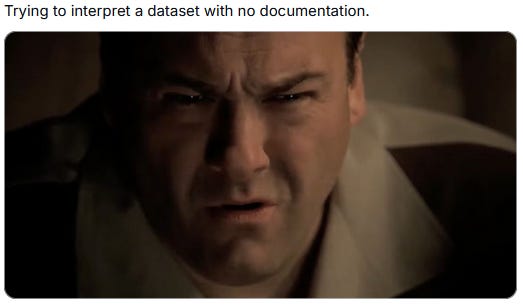
I am taking one week off from the newsletter next week, but will return with Issue 034 on March 3rd.
Thank you for reading! If you enjoy this content, please like, comment, or share this post! You can also support this work through Buy Me A Coffee.