
RDM Weekly - Issue 034
A weekly roundup of Research Data Management resources.


Welcome to Issue 34 of the RDM Weekly Newsletter!
Glad to be back after a week off. So much to catch up on!
The content of this newsletter is divided into 4 categories:
✅ What’s New in RDM?
These are resources that have come out within the last year or so
✅ Oldies but Goodies
These are resources that came out over a year ago but continue to be excellent ones to refer to as needed
✅ Research Data Management Job Opportunities
Research data management related job opportunities that I have come across in the past week
✅ Just for Fun
A data management meme or other funny data management content
What’s New in RDM?
Resources from the past year
1. Updated Elements of an NIH Data Management and Sharing Plan
A week ago NIH released NOT-OD-26-046, which informs readers that as part of its ongoing efforts to increase efficiency and minimize applicant burden, NIH is updating the required elements of a Data Management and Sharing (DMS) Plan. The new plan greatly simplifies the previous format (will download a Word Doc) to a majority checkbox (yes/no) format. A draft of the updated form can be viewed here (will download a PDF). An updated DMS Plan Format page will be made available upon receipt of OMB clearance. Effective for applications submitted for due dates on or after May 25, 2026, applicants and recipients are required to utilize the new, simpler format. NIH is implementing this updated format page as a pilot and will evaluate the need for additional updates over the next year. You can read more about potential pros and cons of the new format (as well as new updates to the NSF DMS Plan) in this post from DMPTool.
2. Making Code Ready for Publication - Slides
In this presentation, Ted Laderas introduces reproducibility as a spectrum. The slides cover the following learning objectives: 1) Why make your code ready for publication, 2) What do you need to make it ready, and 3) How and where do you make it available?
3. Selected Readings on Indigenous Data Governance: 2026 Update
As part of an ongoing effort to contribute to current topics in data, technology, and governance, The GovLab’s Selected Readings series provides an annotated and curated collection of recommended readings on themes such as open data, data collaboration, and civic technology. In this edition, the GovLab curates writings from the last two years on Indigenous data sovereignty and Indigenous data governance. It complements a previous iteration on these topics.
4. 10 years of the FAIR principles - Call for Submissions
The FAIR principles, which provide foundational guidance for sharing data and metadata, were published in Scientific Data in 2016 (Wilkinson, et al). Since then, the core concepts of Findable, Accessible, Interoperable, and Reusable data have become embedded in the design of key infrastructure across the data-sharing ecosystem, including repositories, data standards, policies, and workflows for curating and sharing machine-readable data. To celebrate this milestone, Scientific Data invites researchers to submit manuscripts related to FAIR-aligned infrastructure, policy, or standardisation to this collection.
5. Do University Research Data Management Policies Become More Open Over Time?
Research data management (RDM) policies are ubiquitous in UK Higher Education Institutions, and are often written and managed by, or with, the library team. RDM policies attempt to balance the requirements of keeping data safe and secure when necessary and opening up data to allow reuse and to support research integrity. This article uses a framework analysis approach on 134 policies to investigate whether the UK RDM policies have become more open over time in terms of policy points and language. The investigation shows that recent policies have shown an increased likelihood of being more open in several areas: how long data should be archived for, sharing of software, and the mandatory inclusion of data availability statements in journal articles. Language around FAIR data terms have increased, as has using research integrity as a key reason to manage data according to best practices.
6. PLOS Biology - Formalizing our Commitment to Code Sharing
In support of open science, PLOS Biology routinely asks authors to openly share their research code before publication. They are now formalizing this practice with a mandatory code-sharing policy and this editorial clarifies the what, where, when, why and how of that requirement.
7. Promised Data Unavailable? – I’m Sorry, Ma’am, There’s Nothing We Can Do
In this post, the author walks us through a nine month (and counting) journey of trying to get access to data that is purported to be “available upon request”. The author reviews steps taken to try to retrieve the data, previous experience with data availability statements, and lessons learned about a lack of accountability from some journals who have mandatory data availability statements.
Oldies but Goodies
Older resources that are still helpful
1. How FAIR Are Your Data?
This checklist, originally produced for use at the EUDAT summer school, allows users to assess how FAIR their research data are and what measures can be taken to improve FAIRness (Findable, Accessible, Interoperable, Reusable).
2. 10 Things for Curating Reproducible and FAIR Research
This document describes the key issues of curating reproducible and FAIR research (CURE-FAIR). It lists standards-based guidelines for ten practices, focusing primarily on research compendia produced by quantitative data-driven social science. The “10 CURE-FAIR Things” are intended primarily for data curators and information professionals who are charged with publication and archival of FAIR and computationally reproducible research. Often the first re-users of the research compendium, they have the opportunity to verify that a computation can be executed and that it can reproduce pre-specified results. Secondarily, the “10 CURE-FAIR Things” will be of interest to researchers, publishers, editors, reviewers, and others who have a stake in creating, using, sharing, publishing, or preserving reproducible research.
3. Systematic Data Validation - Recording
In this 3 part recording, Jamie DeCoster (University of Virginia) reviews what data validation is, how to do data validation, and how to document data validation. Part 2 can be found here, and part 3 found here. Slides for the full talk can be found here.
4. Tidyverse Style Guide
Good coding style is like correct punctuation: you can manage without it, butitsuremakesthingseasiertoread. This site describes the style used throughout the tidyverse. It was derived from Google’s original R Style Guide - but Google’s current guide is derived from the tidyverse style guide. All style guides are fundamentally opinionated. Some decisions genuinely do make code easier to use (especially matching indenting to programming structure), but many decisions are arbitrary. The most important thing about a style guide is that it provides consistency, making code easier to write because you need to make fewer decisions.
Research Data Management Job Opportunities
These are data management job opportunities that I have seen posted in the last week. I have no affiliation with these organizations.
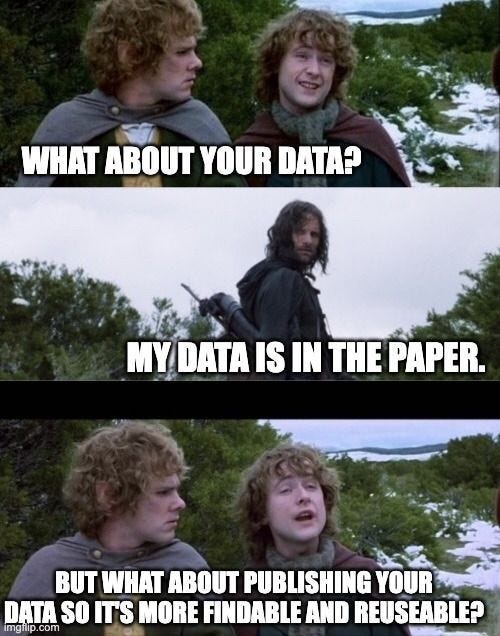
Just for Fun
Thank you for reading! If you enjoy this content, please like, comment, or share this post! You can also support this work through Buy Me A Coffee.