
RDM Weekly - Issue 036
A weekly roundup of Research Data Management resources.


Welcome to Issue 36 of the RDM Weekly Newsletter! 🍀
The content of this newsletter is divided into 4 categories:
✅ What’s New in RDM?
These are resources that have come out within the last year or so
✅ Oldies but Goodies
These are resources that came out over a year ago but continue to be excellent ones to refer to as needed
✅ Research Data Management Job Opportunities
Research data management related job opportunities that I have come across in the past week
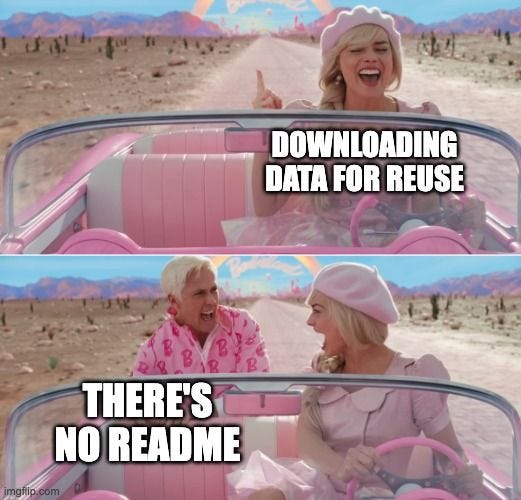
✅ Just for Fun
A data management meme or other funny data management content
What’s New in RDM?
Resources from the past year
1. Data- and Code-Archiving in the British Ecological Society Journals: Present Status and Recommendations for Future Improvements
Despite progress in implementing data- and code-archiving policies in journals publishing ecology and evolution research, issues remain. To be more useful to future researchers, archived data and code must not only be archived, but also meet good practice standards. In this paper, authors collected data from 1,861 papers published between 2017 and 2024 in the seven British Ecological Society (BES) journals. They systematically checked associated data and/or code, metadata, help files and annotations to assess archiving practices. Based on findings, the authors recommend that researchers archive their code, and that archived code be explicitly mentioned in the Data (or Code) Availability statement. They also encourage researchers to provide more accessible and informative READMEs for data and code. To help achieve these recommendations, they advocate that journals employ Data/Code editors to review data and code quality, research institutions deliver more training in open science practices, and funding bodies set clear expectations on open data and code practices.
2. Working with Hard-to-Share Data?
Not all research data can be shared openly. Besides personal data, datasets may also be sensitive for ethical, cultural, commercial or practical logistical reasons. Field notes from ethnographic research, for example, can include reflections from the researcher or contextual information about participants that requires careful handling. At the same time, many researchers want to make their data available for reuse in line with the open science principles: as open as possible, as closed as necessary. This raises questions. What can be shared safely? What requires protection? And how can complex qualitative data be prepared for reuse? Three new guidebooks developed through the Beyond Personal Data project offer practical guidance to help researchers navigate ethical, legal and practical challenges when sharing sensitive data. The three guides include: Hard-to-Share Data in the Social Sciences and Humanities, Sharing Field Notes, and The CARE Principles and Data Ethics.
3. Shadow Systems: The Data Infrastructure Nobody Wants to Talk About
This post is the second in a series on Modern Data Governance. This article in particular discusses shadow systems which are the tools and data environments that exist outside the officially supported institutional systems but still play an important role in how work gets done. The article discusses why shadow systems exist, the challenges created by them, and how to move from shadow systems to living governance. While the focus is on higher education, I think the issues discussed apply to most data work.
4. Data Wrangling in Stata
Most data sets need to be transformed in some way before they can be analyzed, a process that’s come to be known as “data wrangling.” This open access book will introduce you to the key concepts, tools, and skills of data wrangling, implementing them in Stata. The book is meant to complement coursework in statistical analysis, giving you a critical but often neglected piece of the skillset you’ll need to do research with real-world data. Its primary audience is graduate students in the social sciences, but anyone who wants to do data-driven research in Stata should find it useful.
5. Practical Methods for Incorporating Open Science into Your Speech-Language-Hearing Science Research Workflow Across Study Designs
Although speech, language, and hearing researchers express interest in open science, their use of its associated practices is limited and infrequent, given identified barriers in knowledge, skill, time, and cost. This tutorial aims to diminish these barriers by describing various open science practices and activities relevant to speech, language, and hearing sciences. Aligned with a typical research workflow, we also provide a simplified approach for deciding what, when, where, and how to begin. Using examples and considerations across quantitative, qualitative, mixed methods, and systematic review research designs, the authors illustrate practical ways to incorporate open science practices across a researcher’s workflow. This preprint was published online February 2026.
6. Data Governance Toolkit: Navigating Data in the Digital Age
This Data Governance Toolkit reflects a collaborative effort among experts, policymakers, practitioners, civil society and business committed to advancing human rights-based and equitable approaches to data governance. It seeks to design a modular resource to support public institutions, civil society, industry and other stakeholders in designing and implementing data governance systems that are both fit-for-purpose and adaptable to local realities. Rather than prescribing a single model, it provides guiding questions, flexible frameworks, and curates actionable tools to help users navigate the full data lifecycle—from collection and storage to sharing, analyzing and use.
7. RDM Jumpstart - Workshop
This free national workshop, from the Digital Research Alliance of Canada, will introduce participants to best practices in both Research Data Management (RDM) and computational reproducibility with the R programming language. This program is targeted at graduate students and postdoctoral fellows with little to no experience in RDM or coding. While anyone is welcome to apply, applications from current/incoming September 2026 Masters and Doctoral students and Post-Doctoral Fellows will be prioritized. The workshop runs Mondays, Wednesdays and Fridays from May 4-15 and applications are due by April 7th. Additional information can be found here.
Oldies but Goodies
Older resources that are still helpful
1. Agile by Accident: How to Apply Agile Principles in Academic Research Projects
Interdisciplinary research projects dealing with complex issues might need project management approaches that support learning, adaptation, and innovation. Agile is a management approach that has been developed to facilitate collaboration, learning, creativity, innovation, and reflectivity. Due to these qualities, Agile might be a suitable approach to managing interdisciplinary research projects. Agile project management is still new in academic research settings. Only limited information about how to apply it in an academic setting exists. To fill this gap the Agile principles are translated to fit the academic context. The article then outlines how Agile principles can be applied to an academic research program, that did not consciously plan to apply this approach. The translation of the principles will permit other researchers to intentionally use them in their interdisciplinary research projects.
2. R for Excel Users - Workshop Materials
This course is for Excel users who want to add or integrate R and RStudio into their existing data analysis toolkit. It is a friendly intro to becoming a modern R user, full of tidyverse, RMarkdown, GitHub, collaboration & reproducibility. These tools will help learners develop good habits for working in a reproducible and collaborative way — critical attributes of the modern analyst.
3. How to Choose the Right Metadata Standard: A Comprehensive Guide
In today's data-driven world, picking the right metadata standard can feel just as overwhelming and time-consuming as finding the right product in a supermarket. And if we don't have a clear checklist, it's easy to get lost in the sea of existing metadata standards. However, selecting the right metadata standard isn't a 'one-size-fits-all' decision. Organisations differ in size, industry, goals, and technical capabilities, so the chosen standard must align with these unique needs. This post walks you through best practices, essential factors, and expert tips for choosing the ideal metadata standard that suits your current operations as well as adapts to future growth and complexity.
4. Support Your Data: A Research Data Management Guide for Researchers
Researchers are faced with rapidly evolving expectations about how they should manage and share their data, code, and other research materials. To help them meet these expectations and generally manage and share their data more effectively, the authors of this 2018 paper developed a suite of tools referred to as "Support Your Data". These tools, which include a rubric designed to enable researchers to self-assess their current data management practices and a series of short guides which provide actionable information about how to advance practices as necessary or desired, are intended to be easily customizable to meet the needs of a researchers working in a variety of institutional and disciplinary contexts.
Research Data Management Job Opportunities
These are data management job opportunities that I have seen posted in the last week. I have no affiliation with these organizations.
University Hospital of Cologne - Project Coordinator/Data Steward in Clinical Research
Strategic Public Education National Data (SPEND) Initiative - Senior Data Analyst
Just for Fun
Thank you for reading! If you enjoy this content, please like, comment, or share this post! You can also support this work through Buy Me A Coffee.