
RDM Weekly - Issue 044
A weekly roundup of Research Data Management resources.


Welcome to Issue 44 of the RDM Weekly Newsletter!
The content of this newsletter is divided into 4 categories:
✅ What’s New in RDM?
These are resources that have come out within the last year or so
✅ Oldies but Goodies
These are resources that came out over a year ago but continue to be excellent ones to refer to as needed
✅ Research Data Management Job Opportunities
Research data management related job opportunities that I have come across in the past week
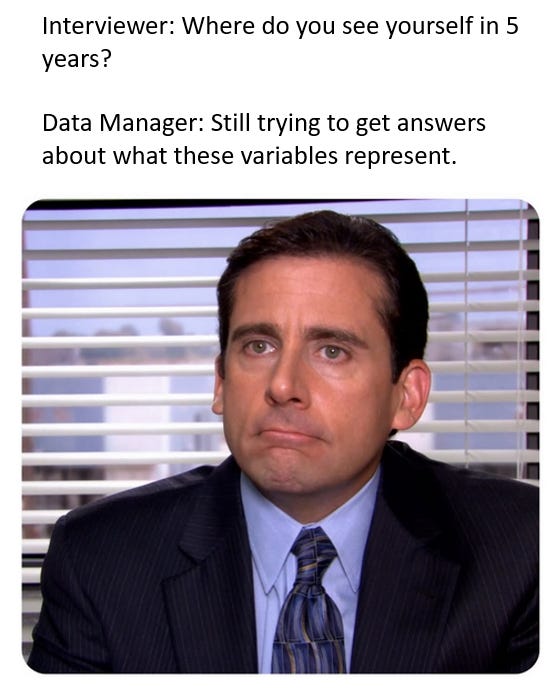
✅ Just for Fun
A data management meme or other funny data management content
What’s New in RDM?
Resources from the past year
1. psychds - R Package
psychds provides tools for creating, editing, and validating psychological research datasets following the Psych-DS standard. The package includes an interactive Shiny application for building Psych-DS compliant datasets from existing directories, functions for validating existing datasets against the standard, tools for generating data dictionaries with professional formatting, and OSF integration for publishing validated datasets.
2. Mind the Gap: A Call for Institutional Investment and Support to Prevent Data Sharing Requirements From Causing Harm
While requiring more public data sharing has admirable goals and great potential benefits, a lack of accompanying support to appropriately assess data before its release undermines the ethics and positive contributions to public-researcher relationships that data sharing is meant to bolster. This article discusses how this gap should be addressed before the impact of easily-anticipated harms becomes undeniable. While research data professionals are likely to be a critical part of the advocacy and collaboration needed to address the issue, the larger-scale investment of resources by institutions in support and education for how to ethically meet these requirements is needed. Without additional support, neither individual researchers nor data professionals will be able to adequately mind this gap.
3. READMEBuilder
REAMEBuilder is a Shiny application that walks researchers through building a high-quality README file for research datasets and code. It automatically describes tabular data columns (ranges, levels, NAs), detects R package dependencies from scripts, supports script run-order documentation, and exports a formatted README.md.
4. Data Curation as Data Literacy Education: Grad’s Declassified Data Survival Guide
To support graduate students in managing their research projects through temporal gaps, the authors created a research data management guide for graduate students, providing easily implementable practices that can be integrated into projects and workflows with as minimal burden as possible to the student or interruption to their team. This quick-start guide is designed to teach graduate researchers data literacy through the curation of their own project materials. In other words, by learning curation best practices and integrating them into an existing research project—where they have a vested interest in seeing the project succeed—graduate students can also become comfortable with how to evaluate data for use in their future research, how to set up projects from the beginning to plan for starts and stops in the work, and how to effectively manage and describe project materials.
5. European Open Science Resources Registry
In the European Open Science Resources Registry, you can find a curated collection of key resources supporting Open Science across Europe, including national policies, strategies, best practices, templates, and impact stories. Users can easily filter resources by country, date, topic, and document type, making it simple to locate relevant information. Policies and strategies are vital to creating a collaborative, transparent, and accessible research environment, and the registry goes beyond simply listing these documents. You’ll find detailed information on each policy, including the option to read full texts where available, helping you understand their scope, implementation, and impact in depth.
6. Your Field Notes are Valuable Research Data - So Share Them
When conducting research fieldwork we generally produce field notes, often as the primary data source or as contextualisation of other gathered data such as interviews. In this post, Pascal Flohr argues that these are an important part of the research dataset and should be shared as openly as possible, and offers things to take into account when deciding to share field notes.
7. A Practical Guide to User-Friendly Data in Publications
This guide from the European Data Portal will help you with all of the data-related aspects of your publication: writing about data, creating data visualisations, and preparing and publishing data. It will provide you with tips and resources that will make the data in your publication more accessible and reusable.
Oldies but Goodies
Older resources that are still helpful
1. Cleaning Excel Data Using R
Excel spreadsheets come in all shapes and sizes. In this 30 minute video, Lee Durbin shows you how to use three packages in R (tidyverse, lubridate, and tidyxl), to whip your spreadsheet into shape in no time.
2. Collection of Open Science Integrity Guides - Citations to Retracted Papers
References to retracted publications can pose a reliability issue in scientific literature since retractions indicate that a publication has been found unreliable. Citations/references to such articles can disseminate unreliable information in the scientific literature. It is stated in Recommendations for the Conduct, Reporting, Editing, and Publication of Scholarly Work in Medical Journals that authors are responsible for checking that none of the references cite retracted articles except in the context of referring to the retraction. However, not all retracted articles are cited after their retraction (post-retraction citations), and not all citations serve the same purpose. It is important to consider the context in which a retracted article is cited. A retraction in the references does not automatically make all citing articles unreliable, but citations to retracted publications can serve as a fingerprint for identifying potential issues in the literature. This guide provides information about how to identify such citations and what nuances should be considered in the analysis and reporting of these cases.
3. Data Journals: Incentivizing Data Access and Documentation Within the Scholarly Communication System
Data journals provide strong incentives for data creators to verify, document and disseminate their data. They also bring data access and documentation into the mainstream of scholarly communication, rewarding data creators through existing mechanisms of peer-reviewed publication and citation tracking. These same advantages are not generally associated with data repositories, or with conventional journals’ data-sharing mandates. This article describes the unique advantages of data journals. It also examines the data journal landscape, presenting the characteristics of 13 data journals in the fields of biology, environmental science, chemistry, medicine and health sciences. These journals vary considerably in size, scope, publisher characteristics, length of data reports, data hosting policies, time from submission to first decision, article processing charges, bibliographic index coverage and citation impact. They are similar, however, in their peer review criteria, their open access license terms and the characteristics of their editorial boards.
4. tidylog - R package
Tidylog provides feedback about dplyr and tidyr operations. It provides wrapper functions for the most common functions, such as filter, mutate, select, and group_by, and provides detailed output for joins. See this vignette for more information.
Research Data Management Job Opportunities
These are data management job opportunities that I have seen posted in the last week. I have no affiliation with these organizations.
Just for Fun
Sponsor
This newsletter is supported in part by the Eunice Kennedy Shriver National Institute Of Child Health & Human Development of the National Institutes of Health under Award Number R25HD114368. The content is solely the responsibility of the author and does not necessarily represent the official views of the National Institutes of Health. Read more about the NIH Data Management for Data Sharing Workshop Project.
Thank you for reading! If you enjoy this content, please like, comment, or share this post! You can also support this work through Buy Me A Coffee.