
RDM Weekly - Issue 051
A weekly roundup of Research Data Management resources.


Welcome to Issue 51 of the RDM Weekly Newsletter!
The content of this newsletter is divided into 4 categories:
✅ What’s New in RDM?
These are resources that have come out within the last year or so
✅ Oldies but Goodies
These are resources that came out over a year ago but continue to be excellent ones to refer to as needed
✅ Research Data Management Job Opportunities
Research data management related job opportunities that I have come across in the past week
✅ Just for Fun
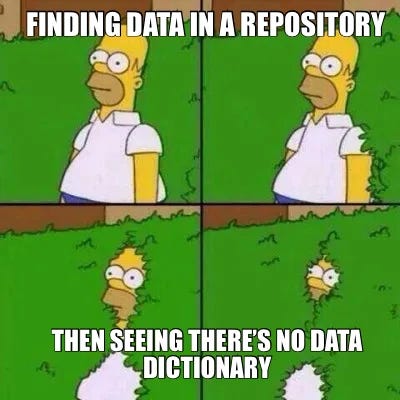
A data management meme or other funny data management content
What’s New in RDM?
Resources from the past year
1. Using Routinely Collected Data for Research Purposes: Challenges and Mitigation Strategies
Increasing availability of large routinely collected datasets presents many possibilities to answer more questions about health and disease, and at a faster pace. These opportunities are exciting, but, without the necessary expertise, well-intentioned researchers can unwittingly fall into traps that make their work indistinguishable from that of less well meaning researchers. This article describes important challenges that arise in the analysis of routinely collected data and offers mitigation strategies to improve the trustworthiness of experimental and observational studies with the aim of explanation or prediction using classical statistical methods or AI algorithms. It also provides a roadmap to support researchers in conducting analyses on routinely collected data that produce more reliable estimates.
2. Research Culture: The Missing Conversation
The article argues that while research institutions invest heavily in policies, procedures, and compliance systems, these alone cannot create genuine integrity. Culture is what shapes behavior when rules are silent or ambiguous. Poor research culture can manifest in authorship disputes, exclusion of contributors, and power imbalances, none of which may violate formal policies but all of which erode trust and collaboration. The author calls on institutions and leaders to go beyond asking "Do we have the right policies?" and start asking whether researchers feel safe, valued, and empowered to do the right thing even without explicit rules.
3. Creative Uses in REDCap
This is a recording from a Lunch, Learn & Collaborate session from FSU Research Computing Center. The topics covered in this webinar included piping, action tags, smart variables, and more. You can find more REDCap Lunch and Learn recordings on their YouTube page.
4. Trust, FAIRness and Impact: Where Electronic Research Notebooks Fit In
This Open Research Perspective, contributed by Dr. James Bird, Technical Specialist in Research IT, explores the relationship between research trustworthiness, evaluability and impact, using data accessibility as one practical lens. It argues that while Open Research has improved the reach of research outputs, greater attention is still needed to ensure those outputs are genuinely assessable, reusable and trusted. Against that backdrop, James considers how Electronic Research Notebooks (ERNs) could help strengthen research workflows and support more FAIR, trustworthy research.
5. ORWG Guide: Reusing Open Datasets
This is one of a series of open research guides aimed at researchers at London School of Economics and Political Science (LSE) (although much of it is applicable to external researchers as well) created under the auspices of LSE's Open Research Working Group (ORWG). With the growth in researchers making their data openly accessible, there is more data than ever available for re-analysis, re-use, and replication studies. This short, one-page guide/checklist gives a short, step-by-step overview of how to go about reusing an existing open access dataset to conduct new research.
6. Preliminary Evidence Linking Open Science to Research Integrity
In this post, the authors ask the question, are open science behaviors really less common in articles that are associated with papermills? To capture open science behaviors, the authors draw on the PLOS Open Science Indicators (OSI) v10 dataset, which includes measures of code sharing, citation of author-generated protocols, preregistration, and preprinting. The dataset covers approximately 139,000 PLOS research articles published since 2018, along with a comparator set of roughly 38,000 articles drawn from PubMed Central.
7. Data Management for Beginners - Recording
This is a recording from the Reveal Research workshop that happened June 12th, 2026. The theme focused on preventing data suffering by thinking about how you will manage your data in advance.
Oldies but Goodies
Older resources that are still helpful
1. EOSC Open Science Observatory
The EOSC (European Open Science Cloud) Open Science Observatory is a platform that tracks how Open Science is progressing across Europe. It provides a clear, data-based overview of policies, practices, and trends in Open Science. Designed for policymakers, research institutions, and other stakeholders, the EOSC Open Science Observatory offers easy-to-understand visualizations and key insights. It supports better decision-making, helps identify progress and gaps, and contributes to a more open and transparent European Research Area.
2. The Open Science Utopia: How Transparency Can Improve Science
What if one of the biggest obstacles to scientific progress isn't a lack of ideas, but the way research itself is organized? In this thought-provoking talk from November 2025, Heidi Seibold shares her journey from researcher to an Open Science advocate. After experiencing firsthand the pressures of academia's "publish or perish" culture, she began questioning a system that rewards publication quantity over research quality. Through personal stories and real-world examples, Heidi reveals how greater transparency, reproducibility, and collaboration can transform research and accelerate solutions to humanity's biggest challenges. This talk explores a compelling vision for the future: an Open Science ecosystem where knowledge is shared freely, research is trustworthy, and scientists are empowered to build on each other's work for the benefit of society.
3. Reframing Repositories: Why Repositories Matter More Than Ever!
To highlight the critical importance of repositories, COAR (Confederation of Open Access Repositories) is publishing a “Narrative Series”. This series provides several compelling, evidence-based portrayals that, taken together, build a powerful case for repositories as essential infrastructure for scholarly communications and the global knowledge commons.
4. Fundamentals of Wrangling Healthcare Data with R
This course will review some of the tools of the trade, namely, R’s tidyverse - a collection of R packages designed with a common framework to aide in common data wrangling and data management tasks. Data Wrangling is one subset set of skills within the Data Science Process. This course will carefully investigate how decisions made while collecting and preparing the data have down-stream effects on model performance. The primary resource is an SQLite database made from downloading various files from the NHANES data source. The goal here is to try to give that experience of connecting to and working with a database with R. Collecting data from a potentially database, running statistical analyses, and making inferences as to which features would perform well when fitting predictive models.
Research Data Management Job Opportunities
These are data management job opportunities that I have seen posted in the last week. I have no affiliation with these organizations.
Project Evident - Associate Director, Data Hub (part-time, remote)
City University of New York - Institutional Research Specialist (Data Integration)
American Heart Association - Project Manager, Research and Data Workflow (remote)
University of South Hampton - Knowledge Exchange and Enterprise Fellow
Just for Fun
Sponsor
This newsletter is supported in part by the Eunice Kennedy Shriver National Institute Of Child Health & Human Development of the National Institutes of Health under Award Number R25HD114368. The content is solely the responsibility of the author and does not necessarily represent the official views of the National Institutes of Health. Read more about the NIH Data Management for Data Sharing Workshop Project.
Thank you for reading! If you enjoy this content, please like, comment, or share this post! You can also support this work through Buy Me A Coffee.