
RDM Weekly - Issue 056
A weekly roundup of Research Data Management resources.


Welcome to Issue 56 of the RDM Weekly Newsletter!
Heads up, there will be no newsletter next week. RDM Weekly will return Tuesday August 18th!
The content of this newsletter is divided into 4 categories:
✅ What’s New in RDM?
These are resources that have come out within the last year or so
✅ Oldies but Goodies
These are resources that came out over a year ago but continue to be excellent ones to refer to as needed
✅ Research Data Management Job Opportunities
Research data management related job opportunities that I have come across in the past week
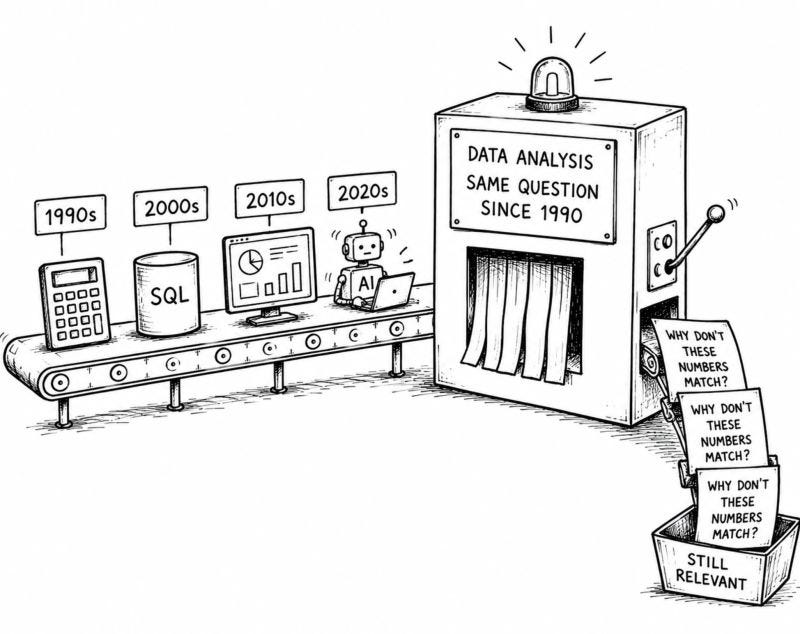
✅ Just for Fun
A data management meme or other funny data management content
What’s New in RDM?
Resources from the past year
1. Announcing the Coalition for Resilient Research Data Infrastructure (CRRDI) Strategic Plan
Since Fall 2025, the Center for Open Science (COS) has been working with a committee of experts in research data infrastructures to develop a strategic plan for the Coalition for Resilient Research Data Infrastructure (CRRDI) — a nascent cross-sectoral coalition working to build a more resilient ecosystem for federally funded research data. Recently they released that draft plan for community comment by September 30, 2026. You can also join them on Friday, August 7 at 2pm ET for a webinar launching the draft strategic plan.
2. Quantitative Research in Organizations Using Excel
This open access book is intended for working professionals interested in learning quantitative research methods in organizational contexts. It serves as an introductory book that provides a basic understanding and perspective for working professionals beginning quantitative research. While statistical concepts are less emphasized, their organizational application has been highlighted. The book is composed of 10 chapters that cover exploring research methods, collecting and preparing quantitative data, conducting ethical research, and more.
3. Reading the Chart Before You Clean It
Using this field guide created by Karin Camila Boynton in conjunction with Claude, begin to understand six dimensions of data quality. The guide includes descriptions, quizzes, and scenarios. After working through the guide, you can try out Part 2, Fixing What the Audit Found. Learn how missing values, duplicates, and entry errors get handled, then practice on a messy export.
4. How to Have Difficult Conversations: A Practical Guide for Academic and Practitioner Research Collaborations
This document from the MIT GOV/LAB is meant to highlight and provide guidance on how to have “difficult conversations” that often arise when academic researchers and practitioners decide to collaborate. The focus here on difficult conversations is intentional because the authors want to hone in on pivotal decision points and issues that are frequently overlooked, or brought up too late. The guide is structured in a series of questions meant to clarify priorities and spell out assumptions. Each section includes questions that both partners should consider together, with specific lists aimed at academics and practitioners. The guide also includes several helpful resources.
5. Guide to Data Tools Landscape for Developers
Written for developers and others new to modern data infrastructure, this article provides a high-level overview of how data moves from collection and storage to processing, analysis, and end-user applications. Along the way, it introduces the key roles, architectures, and tools that make up today's data ecosystem.
6. University of Cambridge Research Data Management Policy Framework
I always like sharing examples of universities that have developed institution-wide research data management frameworks. The purpose of this policy framework is to provide guidance to members of the research community at the University of Cambridge by defining their responsibilities in managing the research data they use and material they produce, securely, legally and ethically, throughout the research data lifecycle. This guidance facilitates the continued maintenance and preservation of research data, making them available to the widest possible audience for the highest possible impact, and in support of the University's mission and core values. It is intended to align with the FAIR and CARE principles. This policy framework applies to all members of staff and students and research-enabling staff (e.g. professional services, technical) at the University.
7. ByteSized dRTP: Secure Data Principles for Digital Research
For this fourth session in the ByteSized dRTP series from STEP UP, happening Wednesday August 6th 10:30am-12pm BST, attendees will be looking at security-by-design principles. As research becomes increasingly data-driven, understanding security is becoming a core professional skill. Attendees will explore how to practically apply security-by-design principles, proportionate to research environments, and how governance, engineering, and research teams can work together to manage risk while keeping pace with innovation. You can register here. Each ByteSized dRTP session also includes a companion podcast episode released through the Code for Thought podcast series.
Oldies but Goodies
Older resources that are still helpful
1. Guidelines for a Codebook
These guidelines, from the Institutes of Education Sciences, describe what a codebook is, why it's important, and what the contents should be. It also provides a brief example codebook.
2. NIST Research Data Framework (RDaF): Version 2.0
The NIST Research Data Framework (RDaF) is a multifaceted and customizable tool that aims to help shape the future of open data access and research data management (RDM). The RDaF will allow organizations and individual researchers to develop their own RDM strategy. The audience for the RDaF is the entire research data community in all disciplines—the biological, chemical, medical, social, and physical sciences and the humanities. The RDaF is applicable from the organization to the project level and encompasses a wide array of job roles involving RDM, from executives and chief data officers to publishers, funders, and researchers. The RDaF is a map of the research data space that uses a lifecycle approach with six stages to organize key information concerning RDM and research data dissemination. An interactive web application has been developed and released that provides an interface for all the components of the RDaF mentioned above and replicates this document. The web application is easy and intuitive to navigate and provides new functionality enabled by the interactive environment.
3. FAIR Data Sharing: The Roles of Common Data Elements and Harmonization
The value of robust and responsible data sharing in clinical research and healthcare is recognized by patients, patient advocacy groups, researchers, journal editors, and the healthcare industry globally. Privacy and security concerns acknowledged, the act of exchanging data (interoperability) along with its meaning (semantic interoperability) across studies and between partners has been difficult, if not elusive. One effort to standardize data collection has been through common data elements (CDEs). CDEs are data collection units comprising one or more questions together with a set of valid values. Some CDEs contain standardized terminology concepts that define the meaning of the data, and others include links to unique terminology concept identifiers and unique identifiers for each CDE; however, usually CDEs are defined for specific projects or collaborations and lack traceable or machine readable semantics. While the name implies that these are ‘common’, this has not necessarily been a requirement, and many CDEs have not been commonly used. This manuscript explores reasons for the disappointingly low adoption of CDEs and the inability of CDEs or other clinical research standards to broadly solve the interoperability and data sharing problems. Recommendations are offered for rectifying this situation to enable responsible data sharing that will help in adherence to FAIR principles and the realization of Learning Health Systems for the sake of all of us as patients.
Research Data Management Job Opportunities
These are data management job opportunities that I have seen posted in the last week. I have no affiliation with these organizations.
Carnegie Mellon University - Postdoctoral Associate in Meta-Research
University of Alberta - Research Data Management Implementation Specialist
Just for Fun
Sponsor
This newsletter is supported in part by the Eunice Kennedy Shriver National Institute Of Child Health & Human Development of the National Institutes of Health under Award Number R25HD114368. The content is solely the responsibility of the author and does not necessarily represent the official views of the National Institutes of Health. Read more about the NIH Data Management for Data Sharing Workshop Project.
Thank you for reading! If you enjoy this content, please like, comment, or share this post! You can also support this work through Buy Me A Coffee.